

Material Engineering & Refractory Alloys
CTI specializes in the production of high-performance contact materials, categorized by their thermal resistance and conductivity profiles.
Our expertise in powdered metallurgy allows us to engineer specific compositions that balance arc erosion resistance with superior electrical transfer.
- Operational Range: 15A to 3,000A
- Standard Compliance: Components for use in UL and IEEE-approved systems.
1. Refractory Metal Composites (High Melting Point)
For applications involving extreme thermal stress, we manufacture silver and copper refractory contacts. The addition of Tungsten (W), Tungsten Carbide (WC), or Molybdenum provides the high melting points necessary to resist welding and arc erosion.
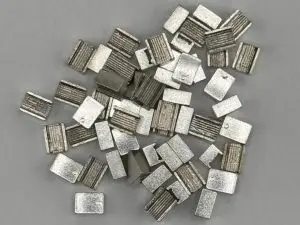
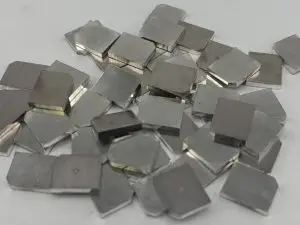
- Silver Refractory: AgW, AgWC
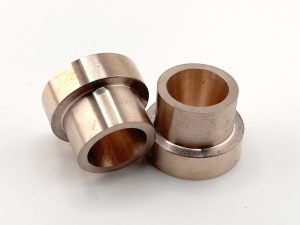
- Copper Refractory: CuW, CuWC
- Performance: Engineered for high-voltage environments where durability against mechanical wear and electrical pitting is critical.
- Best For: High-amperage switchgear, circuit breakers, and grid infrastructure where severe arcing occurs.
2. Graphite & Silver Composites (High Conductivity)
When maximum conductivity is the priority, CTI provides silver and copper graphite composites. These materials offer excellent lubricating properties and resistance to welding, making them ideal for specific sliding and switching applications.
- Compositions: AgC (Silver Graphite), CuC (Copper Graphite), and Fine Silver.
- Thermal Limit: These non-refractory materials are designed for high-conductivity requirements with a thermal ceiling of 950°C (1,742°F).
- Best For: Precision sliding contacts, signal brushes, and stationary contacts.
The following section contains tables which are best viewed on a desktop browser.
Note:
Materials Chart
Effect of Contact Materials on Electrical Performance
| Material | Immediate Temperature Rise | Long Term Temperature Rise | Arc Erosion | Weld / Stick Tendency |
|---|---|---|---|---|
| Silver | ▼Mild decrease |
▬No change |
▲Mild increase |
▲Mild increase |
| Graphite | ▲Mild increase |
▼Mild decrease |
▲ ▲Moderate increase |
▼ ▼ ▼Significant decrease |
| Tungsten | ▲Mild increase |
▲ ▲Moderate increase |
▼ ▼Moderate decrease |
▼Mild decrease |
| Tungsten Carbide | ▲ ▲Moderate increase |
▲Mild increase |
▼ ▼ ▼Significant decrease |
▼ ▼Moderate decrease |
| Large Refractory Material Particles | ▼Mild decrease |
▼Mild decrease |
▲Mild increase |
▲Mild increase |
| Small Refractory Material Particles | ▲Mild increase |
▲Mild increase |
▼Mild decrease |
▼Mild decrease |
Note: Copper can be used to substitute silver in high voltage applications.
All columns are relative to each other. Looking at weld/stick tendency, graphite is the least likely to stick. Tungsten carbide is the second least likely to stick.
Selection Guide
Contact Material Selection Guide
Choosing the right contact material requires balancing electrical conductivity against contact erosion and resistance. Use the summary below to identify the best starting point for your application.
Material Balance
- High Silver/Copper Content: Lower contact resistance and higher conductivity; increased risk of erosion and “sticking” (welding).
- High Refractory Content (W, WC, MO): Superior resistance to arc erosion, mechanical wear, and welding.
Primary Contact Material Families
Material Family | Typical Composition | Best For ... | Key Charateristics |
|---|---|---|---|
Silver Tungsten (AgW) | 10% – 90% Ag | Power switching, circuit breakers | Excellent conductivity + high arc resistance. Ideal for oxidizing atmospheres. |
Silver Tungsten Carbide (AgWC) | 35% – 60% Ag | High-wear applications, anti-sticking | Harder than AgW; superior resistance to oxidation and contact welding. |
Copper Tungsten (CuW) | 7% - 90% Cu | Vacuum, oil, or gas-filled devices. High voltage application | Low-cost alternative to AgW; best in non-oxidizing environments or high-force contacts. |
Silver Graphite (AgC) | 95% – 97% Ag | Stationary contacts, tack-weld prevention | Exceptional anti-welding and conductivity. Often paired with AgW or AgWC moving contacts. |
Silver WC Graphite (AgWCG) | Ag + WC + C | UL/IEC/IEEE approved applications | Cost-effective AgC alternative; balances thermal properties with low erosion. |
Custom Material Engineering
We don’t just provide standard grades; we tailor materials to your specific performance requirements. Our engineers can modify:
- Particle Size & Distribution: To fine-tune mechanical strength.
- Custom Additives: To enhance specific electrical properties.
- Sintering Parameters: Adjusting furnace temperatures to control density and hardness.
Other Available Compositions
We manufacture a wide range of specialized powder metal families, including:
- Silver Molybdenum (AgMo)
- Silver Nickel (AgNi)
- Copper Graphite (CuC)
- Fine Silver (Ag)
Technical Support
We recommend discussing your application requirements early in the design process. Our team can help you select or develop the most cost-effective composition for your specific success criteria.
Problem Solving
Application Engineering & Problem Solving
Designing the right contact is a balance of performance and cost. We specialize in customizing material properties and geometries to solve specific operational challenges.
Common Performance Challenges & Solutions
If you experience... | Engineering Solutions |
|---|---|
High Contact Resistance |
|
Excessive Contact Erosion |
|
Contact Welding |
|
Economics of Contact Design
We help you “design-out” cost without compromising performance. Consider these strategies to reduce material and manufacturing expenses:
- Optimize Composition: Shifting from 50/50 AgW to 35/65 AgW can reduce precious metal costs by 10–30%.
- Material Substitution: Replacing silver graphite with silver tungsten carbide graphite often yields significant savings.
- Geometric Efficiency: * Change square contacts to round to reduce material waste.
- Use a radius face on flat contacts to minimize material volume.
- Add radii to corners of square contacts to lower cost.
- Simplify Manufacturing: Avoid complex geometries that require secondary machining.
- Process Outsourcing: Leverage our specialized equipment for induction, torch, or furnace brazing for higher consistency and efficiency.

